
Bangladesh Mourns: Ex-PM Khaleda Zia Dies at 80—Three-Day National Tribute Announced
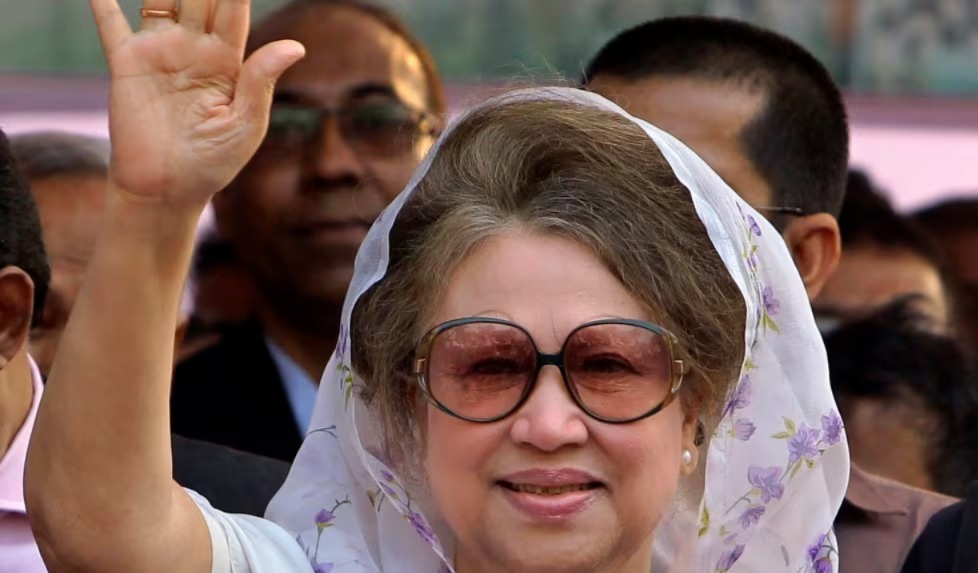
Khaleda Zia, who used to be the Prime Minister of Bangladesh, has died at the age of 80 after a long illness.
Her Bangladesh Nationalist Party (BNP) said in a statement that she died at 6 a.m. local time (00:00 GMT).
“Our dear national leader is no longer with us. We ask everyone to pray for her soul and ask God to forgive her.
Bangladesh Nationalist Party
Zia died at the Evercare Hospital in Dhaka, where she had been admitted on November 23 with signs of a lung infection, according to a news website in Bangladesh. She had advanced cirrhosis of the liver, arthritis, diabetes, and problems with her chest and heart, according to her doctors.
Zia was the first woman to be elected as Bangladesh’s Prime Minister. Her death ends a chapter in Bangladeshi politics that lasted more than 30 years, during which she and her rival Sheikh Hasina were in charge.
Sheikh Hasina was the Prime Minister of Bangladesh.
Sheikh Hasina was the Prime Minister of Bangladesh before.
There is still a lot of disagreement about Zia’s legacy, just like there is about Hasina’s. Both women fought for democracy and against dictatorship. Zia was a polarizing figure, just like Hasina, but she was never accused of committing mass atrocities against her critics.
Her uncompromising style while in opposition, which included leading election boycotts and long street protests, along with repeated claims of corruption while she was in power, made her a figure who inspired strong loyalty among her supporters and equal distrust among her critics.
Zia had been accused of corruption, which she said were politically motivated. She was sent to jail, but in March 2020 she was put under house arrest for humanitarian reasons because her health was getting worse.
The BNP said that after she got out of prison because she was sick in 2020, her family asked Hasina’s government at least 18 times for permission to get treatment abroad, but the requests were turned down.
After Hasina was forced out of office in 2024, the interim government led by Yunus finally let her go. In January, she went to London and came back to Bangladesh in May.
The Supreme Court cleared Zia of all charges of corruption in January 2025. This meant that she could run in the general election in February.
Khaleda had promised to run in elections in February, even though she had been sick and in jail for years. This would be the first vote since the mass uprising that brought down her main rival last year.
Bangladesh says it will mourn for three days.
The interim government of Bangladesh said that there would be a three-day mourning period. A general holiday was also declared for Wednesday, when Zia’s funeral prayers will be held in front of the national Parliament building in Dhaka after midday prayers. She will then be buried next to her late husband, the assassinated former President Ziaur Rahman.
Muhammad Yunus, the acting leader of Bangladesh, made a statement about Zia’s contributions to the country.
Muhammad Yunus is a Nobel Prize winner.
Muhammad Yunus is the acting leader of Bangladesh.
“People will always remember her role in the fight for democracy, a multi-party political culture, and the rights of the people in Bangladesh.”
Muhammad Yunus
Narendra Modi, the Prime Minister of India, sent his condolences in a statement. He said, “As the first woman Prime Minister of Bangladesh, her important contributions to the development of Bangladesh and India-Bangladesh relations will always be remembered.”
Pakistani Prime Minister Shehbaz Sharif called Zia a “committed friend of Pakistan” and said that his government and the people of Pakistan are with Bangladesh “in this time of sorrow.” He went on to say, “Her lifelong service to Bangladesh and its growth and development will leave a lasting legacy.”
Sajeeb Wazed, the son of Sheikh Hasina, who used to be the Prime Minister of Bangladesh, said in a statement that Zia’s death “will have a big effect on the country’s (democratic) transition.” He said that Zia will be remembered for her work in building the nation, but “her death is a blow to stabilize Bangladesh.”
Hasina, who is in exile in India, said in a statement that Zia’s death was “an irreparable loss” for politics in Bangladesh and remembered how she helped build the country’s democracy.